
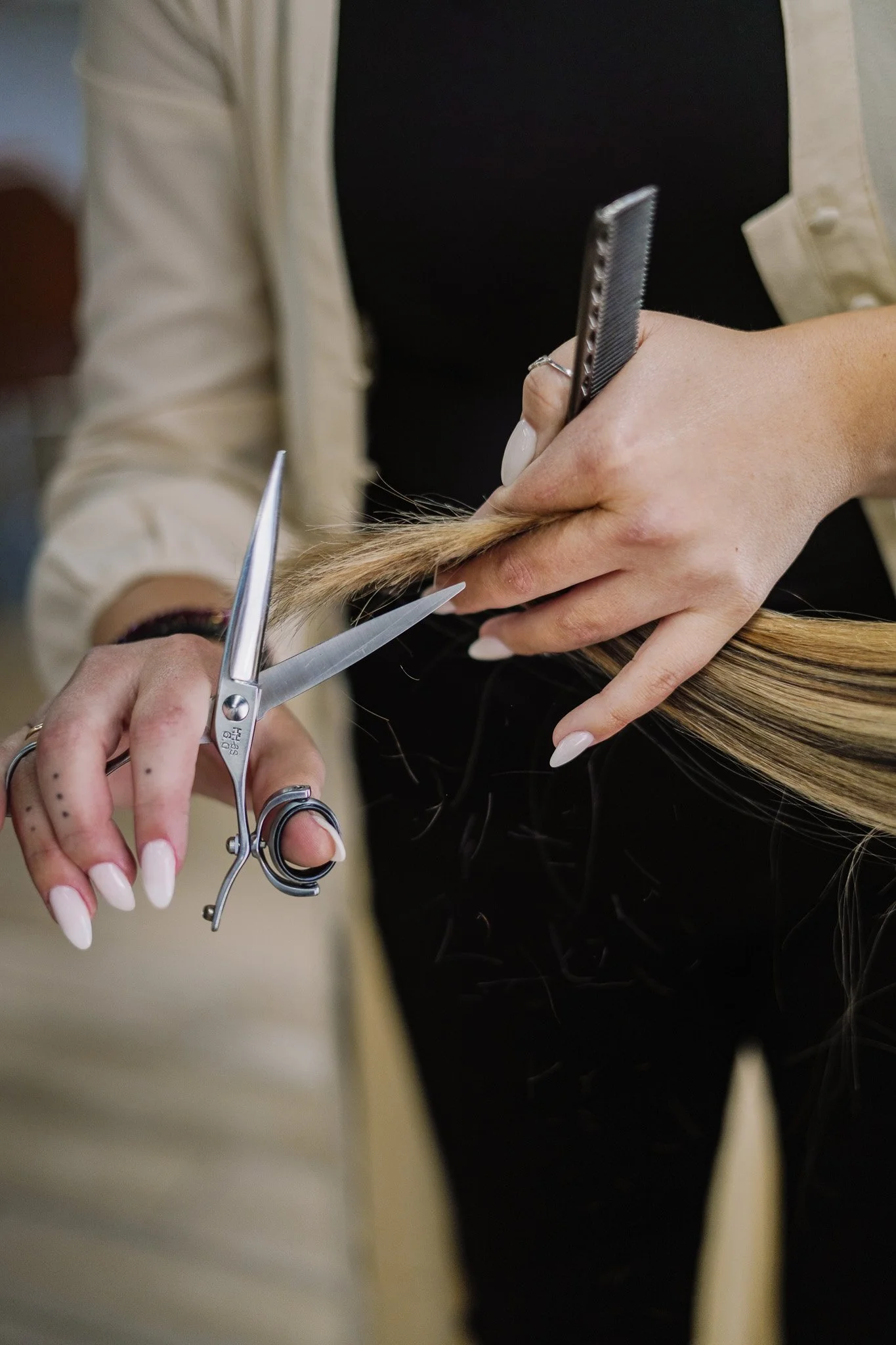
Curtain bangs are the lowest-risk change you can make to a haircut. They alter how your whole face reads, they grow out into face-framing layers instead of into a problem, and if you decide you hate them you can tuck them behind your ears by week three.
The short answer on getting them right: it is all in where the shortest piece starts. Started at the cheekbone they lift and open the face. Started at the jaw they soften and narrow it. That one decision matters more than the length of anything else in the cut.
This is one of the most requested changes on our cuts and styling menu, and one of the easiest to get wrong when it is cut without a plan for the next eight weeks.
What they actually are
Curtain bangs are a fringe cut shorter in the middle and longer at the outer edges, parted so they fall away from the centre of the face on both sides. Hence the name.
Face-framing layers are the same idea without the fringe. The front sections are cut shorter than the rest and graduated back into the length, so there is shape around the face without anything sitting on your forehead.
They are two points on the same spectrum, and in practice curtain bangs grow into face-framing layers over a few months. That is the reason they are such a safe request. The grow-out phase is a style in itself rather than an awkward waiting period.
Where they should start for your face
Round or square face: start higher, around the top of the cheekbone. The vertical lift lengthens the face and the diagonal sweep breaks up width at the jaw.
Long or oblong face: start lower and keep them longer and heavier, closer to the nose or just below. A shorter fringe here exaggerates the length of the face.
Heart-shaped face: middle ground, with the split kept soft. Too short and heavy and it widens an already wider forehead.
Oval face: more or less anywhere works, which is the practical benefit of an oval face. Pick based on how much forehead you want covered.
If you are unsure which you are reading as, our guide to choosing a haircut for your face shape walks through the check in about a minute.
The honest part: they need styling
Curtain bangs are low-commitment. They are not zero-effort, and any stylist who tells you otherwise is setting you up to be annoyed.
They need about two minutes with a round brush or a dryer nozzle to sit the way they do in the photo, and they need it most days. Air-dried, they will do whatever your growth pattern tells them to, which for some people is fine and for others means a stubborn flick at the crown.
If you have a strong cowlick at the front hairline, say so before the cut. It does not rule bangs out, it changes where the split should sit so it works with the cowlick instead of fighting it.
If the tradeoff sounds worth it, this is a good appointment to reserve on its own. Become a WHITEFOX Guest and your stylist will map where they should start on you specifically before any length comes off.
Who they suit, and who they do not
They work well on fine hair, because a fringe adds visible density at the front where it is most noticeable. They work well on wavy and curly hair too, cut dry and longer to allow for shrinkage.
They are a harder fit on very short cuts, where there is not enough length behind them for the graduation to disappear into. They are also a harder fit if you genuinely will not style your hair, and that is a fair thing to decide about yourself.
Keeping them once you have them
Bangs and face-framing pieces are the first part of a cut to drift, because they are the shortest. Most guests need the front reshaped every six to eight weeks even when the rest of the cut can wait to ten or twelve. Plenty of guests come in for a front-only tidy between full cuts, and that is a short appointment.
For events, a blowout is where curtain bangs look their best, because the finish they were designed for is a smooth one.
We don't guess, we design.
If you like this kind of shape change and want to see what else sits alongside it, our piece on current hair trends and timeless styling techniques covers what we think holds up and what does not.
Frequently asked questions
Do curtain bangs suit everyone? Close to it, because the starting point is adjustable. Higher and shorter opens a round or square face, longer and lower suits a long face. The starting point is the part your stylist tailors to you.
How long do curtain bangs take to grow out? About three to four months to blend fully into face-framing layers. Unlike a blunt fringe, the grow-out looks intentional the whole way through, which is why they are a low-risk request.
How much styling do curtain bangs need? Roughly two minutes with a round brush or a dryer nozzle, most days. Air-dried they will follow your natural growth pattern, which suits some people and frustrates others.
Will curtain bangs work with curly hair? Yes, cut dry and cut longer to account for shrinkage. Wet-cutting a fringe on curly hair is the fastest way to end up with something far shorter than intended.
How often do bangs need trimming? Every six to eight weeks, usually more often than the rest of your cut. Many guests reserve a short front-only appointment in between full cuts.
Are curtain bangs the same as face-framing layers? Not quite. Curtain bangs include a fringe that falls on the forehead, face-framing layers shape the front without one. Curtain bangs grow into face-framing layers over a few months.
A change this reversible is worth trying if you have been curious for a while. Reserve time with your stylist or call the salon at (806) 236-6047, and bring the photos you have been saving.
